Zen Of Blissful Boredom Card Deck: Gaslight-proof Your Mind
52 Ways To Trigger‑proof Your Mind After Narcissistic Abuse
Playing with these cards is like giving your mind, body and soul a day out at a luxury spa.
Hello fellow narcissistic survivor!
I’m George Watts—survivor of narcissistic abuse, BWY yoga teacher since 2010, creator of Surviving Narcissism Card Deck and the Blissful Breathing Card Deck.
If you’ve endured the invisible wounds of narcissistic abuse, you know how hard it is to find calm in the chaos. That’s why I created the Zen Of Blissful Boredom: Your Surviving Narcissism Toolkit—a powerful, practical companion to help you calm your way back to peace.
After escaping narcissistic abuse, my yogic breath became my anchor, and so was giving myself permission to be blissfully bored after decades of narcissist chaos.
This is a toolkit for reclaiming your control, calming your nervous system, and reminding yourself: I’m safe now.
And now, I’m sharing that toolkit with you.
What Is It?
This digital card deck includes 52 humorously illustrated cards designed specifically to support survivors of narcissism (emotional trauma). Whether you’re triggered, overwhelmed, or struggling with anxiety, these cards offer a sanctuary of calm when you need it most.
Each card will make you smile, but it also has a serious side…your all important mind-health. Playing with these cards is like giving your mind, body and soul a day out at a luxury spa.
The deck designed to soothe the restless mind by embracing the calm, unhurried art of boredom. Through a delightful combination of mindfulness and humour, this deck encourages you to trade the hustle for a little mindful monotony.
This deck offers a lighthearted yet profound approach to finding peace in the mundane.
Featuring 52 cards filled with simple, humorous, and mindful activities, this deck encourages you to embrace boredom as a gateway to inner calm and creativity.
From quirky challenges to reflective prompts, each card invites you to slow down, let go of distractions, and rediscover the beauty of boredom.
Perfect for survivors of narcissism, the Zen Of Blissful Boredom Card Deck turns dull moments into delightful opportunities for growth and self-discovery.
How Each Card Helps Survivors Like Us
- Regulate your nervous system when triggered
- Ground yourself in the present when spiralling
- Feel safe in your own body again
- Calm racing thoughts and silence the inner critic
- Access peace—even when chaos surrounds you
Each card is designed for people recovering from the kind of mind-warping experiences that narcissistic abuse creates. Whether you’re just starting your healing journey or years along the path, this deck meets you where you are.
Perfect Companion
Oh yes, I almost forgot. These cards are the perfect companion for the Surviving Narcissism Card Deck and Blissful Breathing Card Deck.
Zen Of Blissful Boredom Card Layout
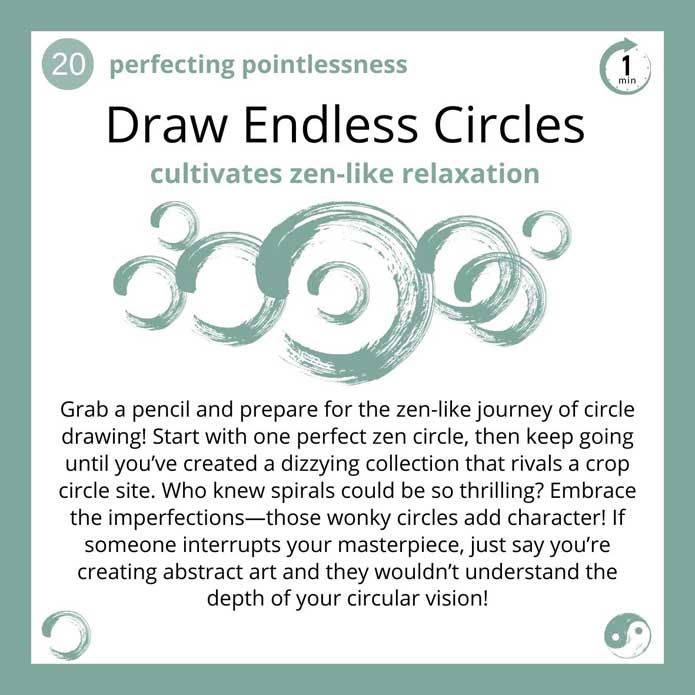
Each card has the following eight zen features:
- Colour: Coloured border because Zen should be stylish
- Numbered: Numbered by category (52 cards)
- Instructions: Step-by-step, no extra jargon.
- Benefit: The exercise’s Zen superpower
- One Minute Timer: A reminder to practice for one minute
- Illustration: Simple illustration (because Zen is simple)
- Zen Circle Symbol: A reminder that it’s a Zen exercise
- Yin Yang Symbol: A reminder of harmony and wholeness
The 52 Blissful Boredom Cards In The Deck
Below are the 52 blissful boredom cards in the deck:
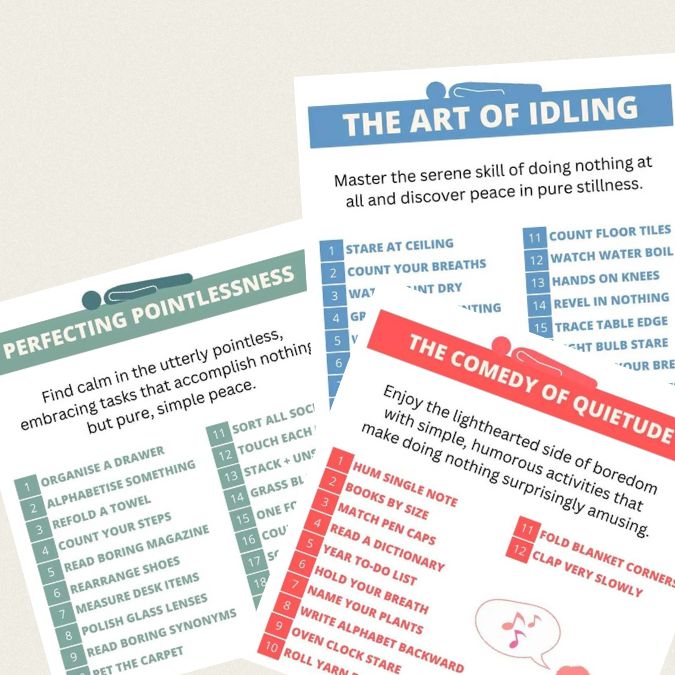
Each card offers a light hearted suggestion to bring more Zen into your day. There are three categories: the art of idling, perfecting pointlessness, and the comedy of quietude.
Blue Category: 20 Art of Idling Cards

This category is all about mastering the simple joy of doing absolutely nothing—perfect for finding your Zen.
The 20 Art Of Idling Cards:
- Stare at Ceiling
- Count Your Breaths
- Watch Paint Dry
- Lie on Floor
- Watch Clouds Drift
- Stare Out Window
- Count Your Blinks
- Listen to Refrigerator
- Wall Spot Gaze
- Notice Every Sound
- Count Floor Tiles
- Watch Water Boil
- Hands On Knees
- Revel In Nothing
- Trace Table Edge
- Light Bulb Stare
- Observe Your Breath
- Imagine Deep Silence
- Watch Shadows Move
- Feel Your Pulse
Green Category: 20 Perfecting Pointlessness Cards

This category is all about embracing the trivial, the unimportant, and the satisfyingly purposeless.
The 20 Perfecting Pointlessness Cards:
- Organise A Drawer
- Alphabetise Something
- Refold A Towel
- Count Your Steps
- Read Boring Magazine
- Rearrange Shoes
- Measure Desk Items
- Polish Glass Lenses
- Read Boring Synonyms
- Pet the Carpet
- Sort All Socks
- Touch Each Page
- Stack + Unstack Cups
- Grass Blade Gaze
- One Foot Balance
- Count Ceiling Marks
- Sort Recyclables
- Polish Door Knobs
- Fold Paper Perfectly
- Draw Endless Circles
Red Category: 12 Comedy Of Quietude Cards
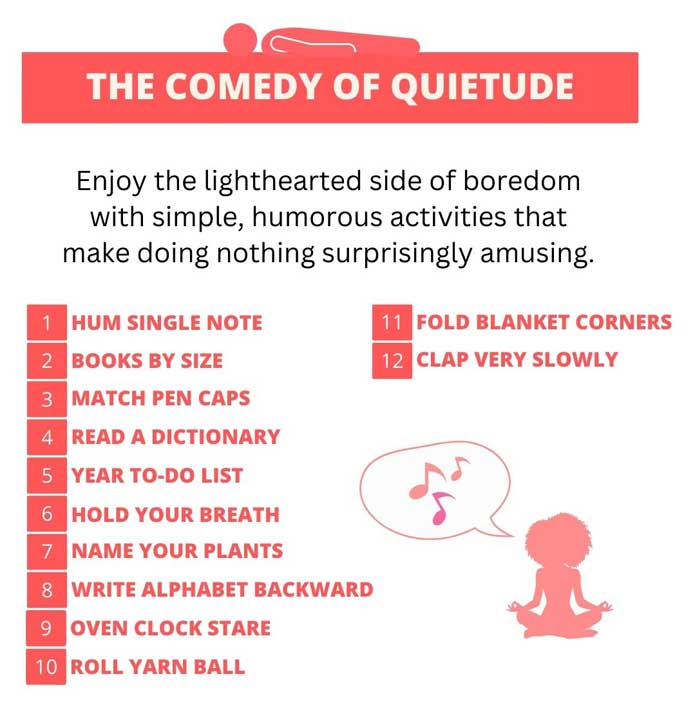
This category is all about discovering the gentle humour in the mundane with activities that invite a smile as you explore the simplest pleasures.
The 12 Comedy Of Quietude Cards:
- Hum Single Note
- Books by Size
- Match Pen Caps
- Read A Dictionary
- Year To-Do List
- Hold Your Breath
- Name Your Plants
- Write Alphabet Backward
- Oven Clock Stare
- Roll Yarn Ball
- Fold Blanket Corners
- Clap Very Slowly
Each of the 52 cards offers a guided Zen activity to bring you back to the present, restore peace of mind, and maybe—just maybe—make you laugh in the process.
Why Boredom?
Boredom isn’t something to be feared; it’s an invitation to slow down, reset, and let your mind breathe.
Embracing boredom is scientifically proven to:
- Reduce Stress: Letting go of stimulation relieves mental pressure and soothes the soul.
- Boost Creativity: Stillness invites new ideas and gives your mind space to wander.
- Enhance Focus: Boredom is a shortcut to mindfulness, bringing clarity and calm.
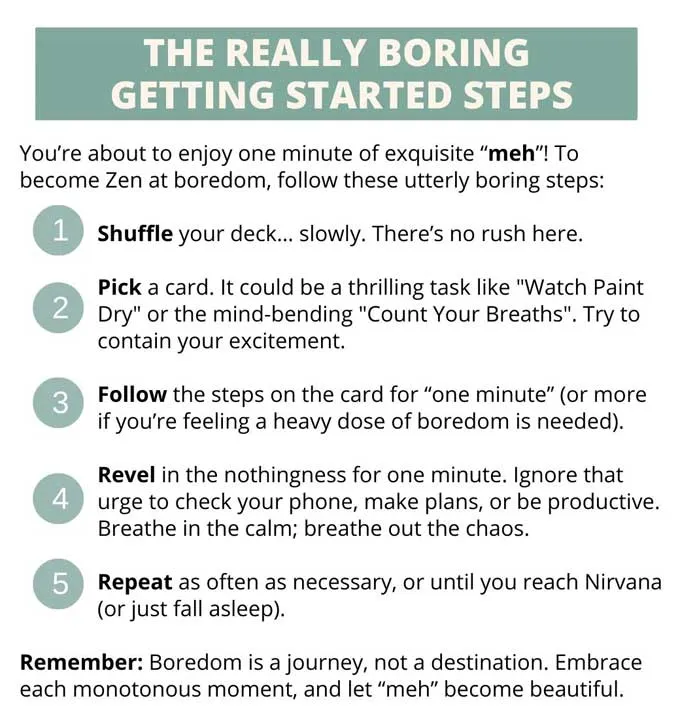
Getting Started Steps: The Boring Version
The activity on each card is crafted to gently nudge you away from the chaos and into calm. After narcissistic abuse, these cards let you take a guilt-free time-out.
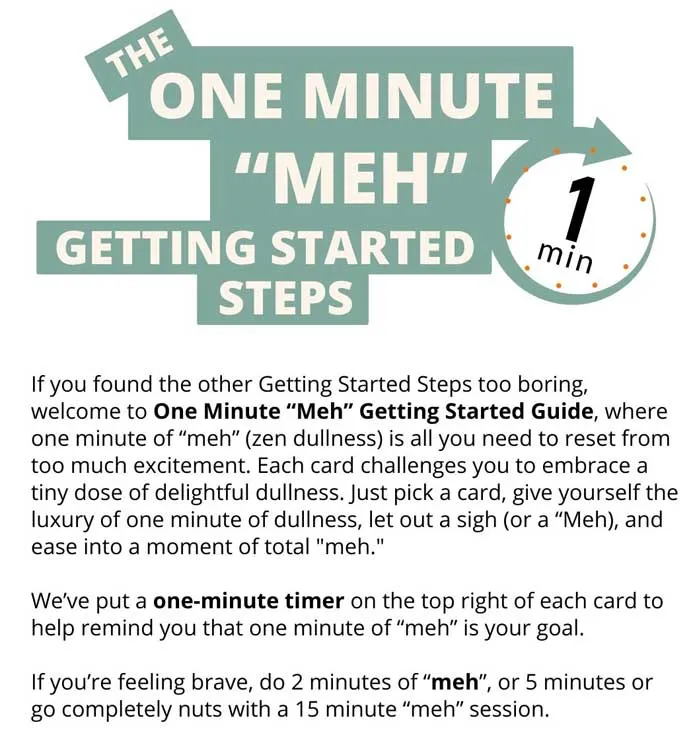
Getting Started Steps: The “Meh” Version
Swipe Right For Healing: Explore On Any Device

Unlock the healing magic of the cards by accessing the PDF on your iPad, Tablet, or Phone. Dive into your digital healing journey—just download the PDF, sit back, and swipe through each card. It’s like having a surviving narcissism zen master therapist in your pocket.
“Meh” Workout Routine Card
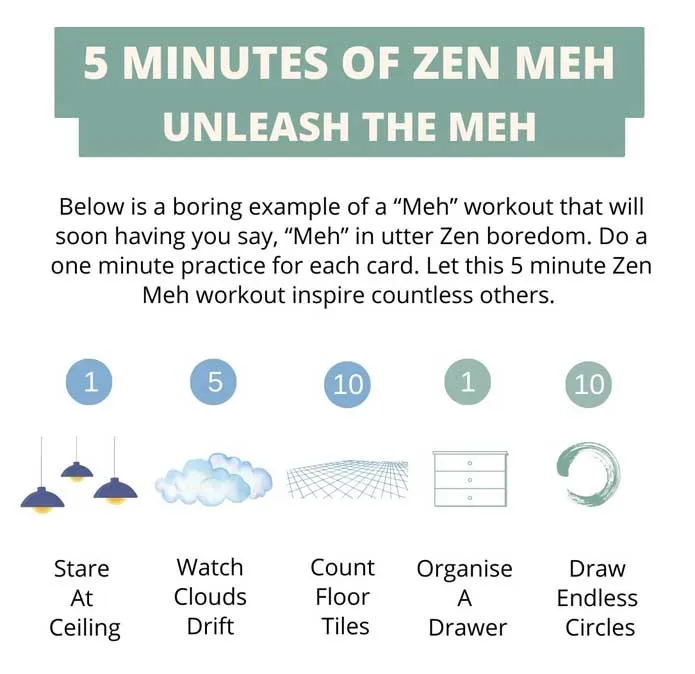
Okay, I admit it. This was a very silly card to add to the deck, but this is after all a humorous deck, and I thought having an example of a “Meh” workout routine would make you laugh.
What is a “Meh” workout routine?
To find out, scroll down a bit to the next section to discover the definition of the word “Meh”.
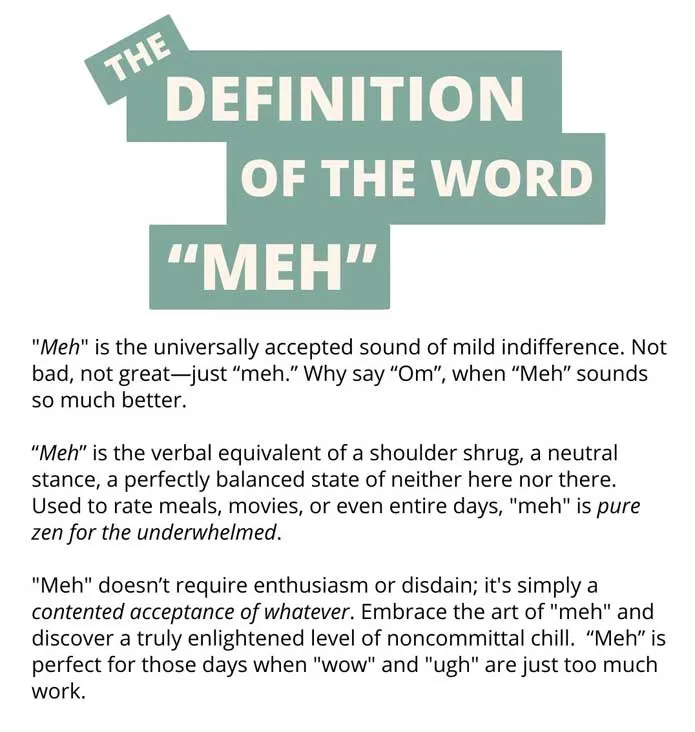
The Definition of ‘Meh”
Here’s the definition of the word “Meh” …
What Are Others Saying About The Deck?
“I never thought I’d say this, but being bored has become my new favourite hobby! These cards helped me go from constantly on edge to actually enjoying slow moments. I keep one on my desk to remind me it’s okay to just breathe and do nothing. Thank you, George, for turning boredom into a superpower!”
— Emily B., survivor and newly minted boredom enthusiast
“After years of narcissistic chaos, I didn’t know how to just ‘be’. This deck made me laugh, cry, and finally exhale. Each card feels like a hug from someone who gets it. Now, I look forward to my daily dose of blissful boredom more than my morning coffee!”
— Mark L., recovering people-pleaser
What’s In Your Zen Of Blissful Boredom Swag Bag?
Here’s what you’ll get:
- A link to download the 52 cards in JPG format—perfect for your digital collection.
- Another link for the 52 cards in PNG format—because who doesn’t love options?
- A high-quality PDF of all 52 cards, for those who prefer their blissful boredom in paper form.
- A super helpful guide on using the cards to cultivate inner calm.
- 1 “Meh” workout routine card to inspire your blissful boredom workouts
- A 4-minute video demonstrating how to print at home (or convince your printer to behave).
Digital Download
After purchasing, you’ll be whisked away to SurvivingNarcissism.co.uk and your very own “Account” page. Click “Download Files” next to your order—go ahead, go wild! Download as many times as you want, whenever you want. Your files will be patiently waiting on the “Your Account” page, ready for action.
Printing
You can print the cards from your printer at home or send them to a local or online printer to print (you’ll only need to print 16 pages).
Terms Of Use
These files are for your personal use only. Therapists, feel free to sprinkle them into your sessions if you’re a therapist, but remember: no selling, no reselling, and no giving them away like it’s Christmas. Keep the good karma going! If your clients start eyeing your cards, just tell them to grab their own deck here.
Surviving Narcissism FAQs

What are the top 12 warning signs that my mother or father is a narcissist?
If you think you were raised by a narcissistic parent here are some warning signs to look for:
- 99% of the conversation is about themselves (their favourite subject)
- Immature behaviour
- Selfish behaviour
- Brags about your achievements to others, but almost never supports you emotionally
- Constantly blames others for problems that stem from their behaviour
- Well-liked and/or important to others, but controlling and manipulative when no one is looking
- Makes you feel bad for not doing what they want immediately
- Makes you feel guilty by boasting about how much they have done for you
- Ruthless – doing anything to be and stay on top
- Unforgiving
- Makes you feel anxious
- Sabotages your confidence
What are the 7 most common traits of adult children who grew up with narcissistic parents?
1. Guilt
Adult children of narcissistic parents fear that they will hurt someone else by choosing to do what’s right for them. They have been trained to consider their parent’s needs first and foremost, and it is therefore hard for them to consider their own needs without feeling selfish for doing so. This guilt and indecision can be all-consuming for years.
2. Low Self-esteem
Gaslighting is a form of manipulation in which the parent will covertly sow seeds of doubt in their child, making them question their own memory, perception, or judgement. A classic example is when the narcissist blatantly lies so that you’re not sure in the future what is true and what is not. Another classic narcissist ruse is when the parent denies an experience from the past ever took place, invalidating the child’s feelings about the event.
Growing up with a narcissistic parent can leave the adult child feeling that they have very little to offer, even when the contrary may be true. Growing up, their talents and skills may have been downplayed, ignored, or co-opted by the narcissistic parent who will have felt threatened by their child’s skills. Even when a survivor of narcissism experiences success, they can feel that they don’t deserve it which may give rise to impostor syndrome.
3. Get Into Other Relationships With Narcissists
Even after growing up amid lies, manipulation, and abuse, it can be really difficult for adult children of narcissists to step away from caring for and loving a narcissistic parent. They will likely feel guilt for trying to step away or build boundaries, and may even enter into relationships with partners who show narcissistic traits. Love based on manipulations and conditions is something that is known to them, whereas unconditional love might seem daunting.
4. Compassion For Others
Most adult children of narcissistic parents display a great ability to show compassion and love for others, are able to form loving relationships, and learn to love and care for themselves. It is possible to recover from growing up with a narcissistic parent.
5. Self-Blame
A narcissistic parent is always emotionally tone-deaf, and are constantly preoccupied with themselves to be aware of the emotional needs of their child. In order to try to maintain the family unit, the child (even as an adult) shies away from blaming their parent and instead takes all the blame on themselves. The mantra going on inside their heads is: “If I was better at XYZ my dad/mum would love me.”
This can continue into adulthood, where the adult child continues to take the blame for things that aren’t always their fault. They become the scapegoat in many situations to keep the peace.
6. Fear Taking Any Attention Away From The Narcissist
Narcissistic parents can explode into anger or burst into tears without much warning, which forces their children to take up as little space as possible in order to avoid triggering one of these emotional outbursts (and also fearing taking any attention away from the narcissist in the process). It can feel like walking on eggshells – trying to do everything possible to avoid their parent having a meltdown.
7. Insecure Attachment To The Narcissist Parent
Adult children of narcissists are prone to become insecurely attached to their parent, which prevents them from a healthy exploration of their environment. My brother is four years older than me. When I was 18 and was contemplating going to University in America (I lived in the UK) he told me: “Great idea. Get as far away from XYZ (our narcissist parent) as you can.” Thankfully, I took his advice but was made to feel guilty every time I called or returned in the Summer months to visit.
The neglect, manipulation, or emotional absence of a parent can leave their child questioning how safe they will be able to feel in other people’s hands. This leads some adults to become fiercely independent, not trusting that anyone else can be relied upon. It can, however, lead others to cling to their partners for love and demand the attention of their significant other at all times.
What is a parentified child?
Children who grow up with a narcissistic parent will have organised their whole life and personality around the happiness of their parent, and will then grow up organising their life around the happiness of others – many of them working in the helping profession.
Do narcissist live vicariously through their child?
Yes. Narcissists love nothing more than living vicariously through their children.
For example, my brother was a top-ranked professional golfer. Our narcissist parent basked in the glow of his success because it made him look great to strangers. Those of us on the inside (close family members) knew very well that any “help” that was given to my brother was purely to inflate the narcissist’s grandiose sense of self.
To this day my brother and family members are constantly reminded of all the help and sacrifice given by the narcissist. It’s like listening to a broken record. Narcissists constantly embellish and exaggerate the help they give.
They do this to fish for admiration.
Why are narcissists threatened by your differences?
If you think differently or interpret something differently to a narcissist, they will take offence to it.
If you don’t think and act like them, they will be threatened by you. It’s because the narcissist has no empathy. They simply don’t ever see life from another person’s perspective – getting psychologically into someone else’s shoes is a no-no for a narcissist.
They have zero curiosity about you and how you feel. If you dare to be different in any way from a narcissist, it means they are no longer the centre of the Universe which is a psychological death for them.
Why do narcissists create so many enemies?
If you think differently or interpret something differently to a narcissist, they will take offence to it, and it will turn into an adversarial interaction very unnecessarily. They are experts at turning any issue into a “right or wrong” mentality.
They crave being correct and superior at all times. They have no capacity to collaborate. That is why a narcissist can’t help but see enemies everywhere they look. If you’re not willing to be an exact clone of them, then you are an enemy.
Don’t be drawn into the fight with them!
That’s exactly what they want you to do. You’ll never win a fight with a narcissist. You will always be wrong. They are empty people and the way they temporarily fill that void is by fighting, moodiness, tantrums, and petty arguments.
Why do narcissists have zero introspection abilities?
Narcissists go so deep into their alternate reality that when you come along and say: “Let us think things through a bit differently,” they will say: “No, my mind is already made up, and if there’s a problem between you and me then you’re the problem.”
They go deep into blame, accusing and forceful mode if you dare to think and act differently from them. Your differences will trigger their exploitation, manipulation and control mode.
Do narcissists view relationships as a hierarchy?
Yes!
Instead of looking at relationships as a collaborative (equal to equal) engagement, a narcissist looks at relationships as a hierarchy.
They think of “who is above” and “who is below” in this relationship. And you’ve guessed it, they want to be “above”. They always want to be the top dog. They don’t value differences and uniqueness.
They value power and control over others.
Do narcissists know how to be friends?
No!
Unless you become a clone of them, but that isn’t friendship. That’s an unhealthy co-dependency. They simply don’t know how to be friends.
Friends have the mindset of bringing their pluses and minuses to the equation and figure out how to accept, encourage, and accommodate one another in a healthy uplifting way. That kind of thinking is lost on a narcissist.
They have a long history of people not liking them (except for strangers who they go all out to impress), and they’re constantly trying to rationalise as to why it can’t possibly be a reflection on them.
That means they miss out on the steps needed to build friendships!
They much prefer collecting enemies versus friendships. This is, of course, all subconscious. They won’t be aware that they sabotage friendships.
What percentage of the population are narcissistic?
Most psychologists would say approximately 10% of the population are narcissistic.
What are the 4 types of narcissism?
The four main types of narcissism are: grandiose, covert, malignant and communal.
What is a grandiose narcissist?
The four main types of narcissism are: grandiose, covert, malignant and communal.
The classical narcissist is the “grandiose” type.
They are known to be very egotistical, arrogant, attention-seeking, and validation-seeking. They want you to admire their lovely house, car and possessions. And most of all they don’t bother listening to anyone.
The only person that matters in the room is themselves.
They are the universe and everyone else must revolve around their whims, desires, and needs.
What is a malignant narcissist?
The four main types of narcissism are: grandiose, covert, malignant and communal.
The malignant narcissist is all the things a grandiose narcissist is (lacking empathy, entitled, grandiose, and pompous) but they are also really mean.
They will do really bad things and feel little to no guilt, which puts them almost on the psychopathic spectrum. They constantly lie, cheat, and steal.
They are your Bernie Madoff types ( Bernie was an American fraudster and financier who ran the largest Ponzi scheme in history, worth about $64 billion).
What is a covert narcissist?
The four main types of narcissism are: grandiose, covert, malignant and communal.
The covert narcissist is someone who is very put upon by the world (underachievers), but are still grandiose. They might say something like: “I’m a really great painter, but the world never really recognised my greatness.”
They feel like life did them wrong.
They can be very passive-aggressive.
They can come across as depressed, but they aren’t.
No amount of medication will make them feel better.
They will always have the mindset of “Woe is me. Nobody sees how great I am.” They will always be hypersensitive to criticism. They will always be mad at the world. They will always blame the world for their situation.
They will always feel like the victim.
They will never take ownership of their actions.
What is a communal narcissist?
The four main types of narcissism are: grandiose, covert, malignant and communal.
The communal narcissist is someone who says things like: “I’m off to feed the homeless today” (while they are dressed in expensive clothing). Or they may say: “It’s dog rescue day on Thursday.”
They are always trying to save the world.
They go to lots of events, but they need a lot of recognition. They love nothing better than having a building named after them. They walk around saying: “Look at all the amazing good I do for the world”.
They constantly let others know about their goodness and giving nature.
The irony is that they have zero empathy for the people they are trying to help!
All they want is recognition and validation for all their good work. They wouldn’t dream of ever doing good quietly. They will inform as many people as possible about their good deeds.
Are men more likely to be narcissist?
Yes!
Narcissism is much more prevalent in men.
The ratio is 80/20 (80% men, 20% women). Part of the reason for this disparity is because men aren’t taught to show their emotions when growing up. Emotions aren’t widely valued for boys and that sets up a life path lacking in empathy, compassion, and vulnerability.
Men are also measured on their achievements: making lots of money, having a big title, and having a big house. These are all superficial drives and are the ingredients for creating a narcissist.
Can narcissists be generous?
Yes.
They may buy everyone big expensive meals, and send them on big vacations to create an illusion that there are lots of people around them.
Those people wouldn’t be around just on the basis of how the narcissist treats them. If the narcissist didn’t buy the meals and holidays, the people around him/her wouldn’t be around for long…and the narcissist is very aware of that.
“Hey George, your Zen Of Blissful Boredom Card Deck looks like a fun way to heal! I can’t wait to start using it on my healing journey!”
George Watts

Survivor of Narcissistic Abuse
BWY Yoga Therapy Teacher
Creator of the Surviving Narcissism Card Deck
Got Questions? I’m here to help–Email Me
P.S. Ready to embrace the art of being delightfully, mindfully bored? Order your Zen Of Blissful Boredom deck today and discover the joy of taking a well-deserved pause.
P.P.S. Got questions about the Zen Of Blissful Boredom Card Deck, I’d love to help—just shoot me an email.
P.P.P.S. If you’re in a narcissistic relationship, or recently extracted yourself from one, you might like my Surviving Narcissism Card Deck.